


In practical computer vision systems resampling is commonplace. Format conversion, rectification, and warping are all operations that involve resampling.
Therefore there is considerable interest in
developing resampling schemes that operate with any scaling factor without
user intervention. Most resampling methods assume that the original intensity distribution
is correctly sampled and construct new images by linear filtering
followed by resampling. It is the design of the filter that is
usually the subject for discussion since one seeks to
remove the aliases due to sampling in some mathematically tractable fashion.
If a quantitative quality measure is given for an interpolation technique it is usually obtained by contracting then expanding the image back to its original size and computing the error between it and the original. For example, in a recent paper [12], images are contracted and expanded by a factor  and compared quantitatively on the basis of signal-to-error ratios.
However, several studies [15, 6] have concluded that both signal-to-error ratio (SER) [4], and gradient-weighted error [16], are unsatisfactory measures of perceived image similarity.
In Figure 1, for example, images have been corrupted with additive noise, with different spatial correlation functions, but with identical signal-to-error ratios of 20 dB. At normal viewing distance readers
with normal eyesight will find the left-hand image in Figure 1 considerably more
disturbing than the right.
and compared quantitatively on the basis of signal-to-error ratios.
However, several studies [15, 6] have concluded that both signal-to-error ratio (SER) [4], and gradient-weighted error [16], are unsatisfactory measures of perceived image similarity.
In Figure 1, for example, images have been corrupted with additive noise, with different spatial correlation functions, but with identical signal-to-error ratios of 20 dB. At normal viewing distance readers
with normal eyesight will find the left-hand image in Figure 1 considerably more
disturbing than the right.
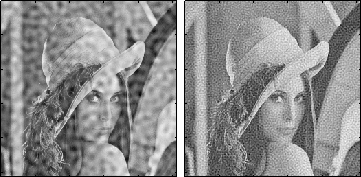
Figure: Images corrupted with additive Gaussian noise with a centre
wavenumber of 8  radians per degree (left) and 32
radians per degree (right). Correct viewing distance is
51 cm.
radians per degree (left) and 32
radians per degree (right). Correct viewing distance is
51 cm.
In the absence of quantitative models of the human vision system a crude approach based on signal-to-error ratios is understandable. However, recently, simple models of the human vision system have become available ([15, 18, 17] for example). In this paper we adapt such a model, originally developed for examining coding errors, and test its effectiveness with resampled images.